
Linn County Directory Collections
The central Linn County city directory collection is the Cedar Rapids Directories and Phone Books run in the Cedar Rapids History Archive. Its catalog spans 1876 through 2017 and counts 132,763 pages. That range does not mean every year is present or every book follows one format. Publisher, coverage, and sections can change. The archive lets a reader browse by title and decade, search OCR text, and then inspect the page image. OCR is computer-read text and can miss faint type, initials, and tightly packed columns.
| Collection | Years | Where Held | Access |
|---|---|---|---|
| Cedar Rapids directories and phone books | 1876-2017 | Cedar Rapids History Archive | Free online browse and search |
| McCoy city directory | 1914-1915 | History Archive sample volume | Online page images |
| Sanborn fire insurance maps | 1884-1936 | History Archive | 197 digitized pages |
| Local maps and atlases | 1859-1950 and 1881-1938 | History Archive and local collections | Online and archival |
| People, business, and school files | Varies | The History Center | Staff-assisted or in person |
Use the exact title and page date in a citation. If a year is absent online, call the library or History Center before assuming no volume survives. A print copy, microfilm reel, or staff file may fill the break.
Search Linn County Directory Images
The Cedar Rapids History Archive supports a surname-plus-place or surname-plus-year search. Browse the title or decade after the first hit, then open the page itself. Search variants matter: try initials, a shortened first name, alternate spelling, and the spouse's name. A single OCR match can point to the right page, but the type on that page controls the transcription.
The Cedar Rapids Public Library digital-resources page also explains which resources are open on the web and which licensed tools require a library card or an in-library visit.
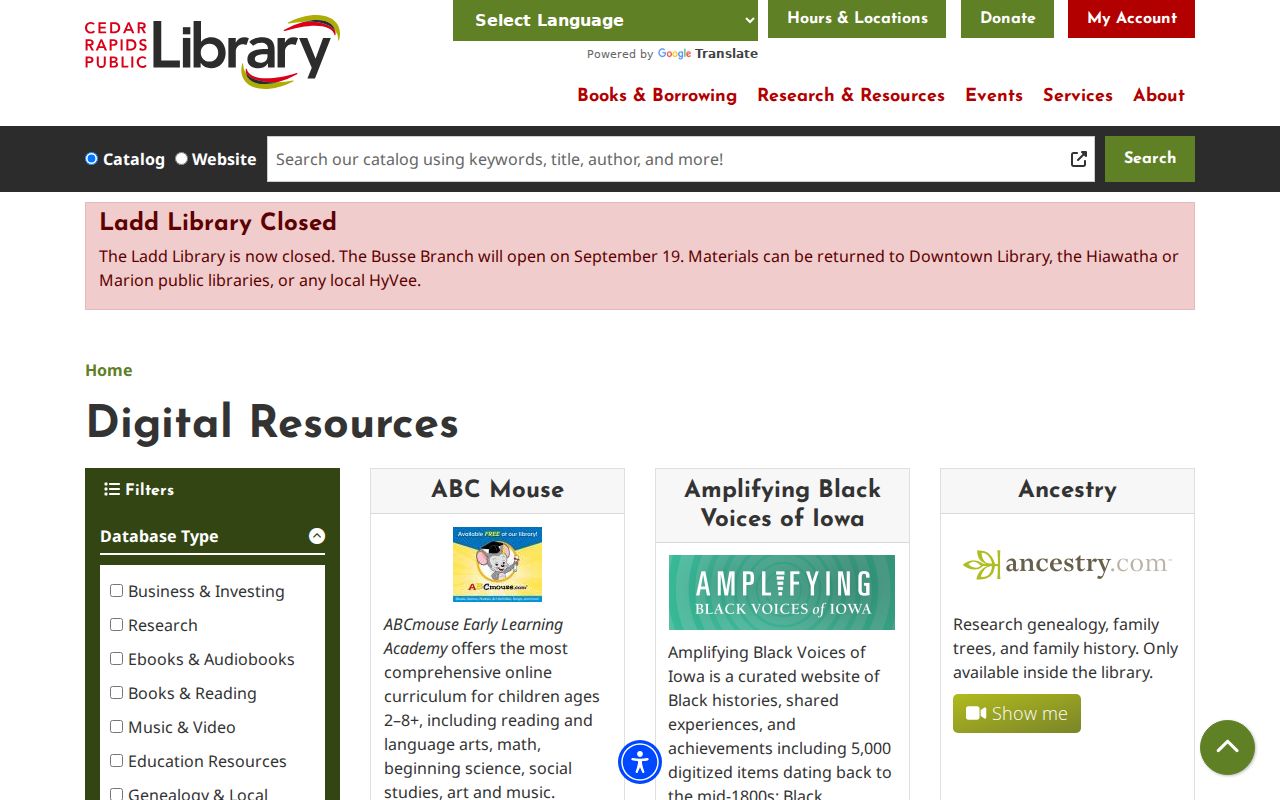
The library screen is the practical gateway when a directory clue needs a newspaper, census, or other licensed record for confirmation.
Decode a Linn County Directory
McCoy's 1914-1915 volume shows why an old Linn County city directory is more than a list of names. It advertises alphabetic entries for private citizens and firms, a street directory, a street and avenue guide, a numerical telephone section, and pages for civic officers, churches, schools, banks, railroads, societies, and classified businesses. Record what is printed, including punctuation and abbreviations. Do not add a spouse, ownership status, or job unless the entry or the book's key supports it.
| Printed name | Copy initials, spelling, and any household wording exactly. |
|---|---|
| Occupation or firm | Shows the role listed for that edition, not a permanent identity. |
| Street address | Keep the house number and Cedar Rapids quadrant suffix together. |
| Telephone | May appear in a separate numerical section as well as an entry. |
| Edition details | Save the title, publisher, year, and page for later checks. |
- Criss-cross directory
- A directory arranged by street or phone number instead of only by surname. McCoy's street and numerical telephone sections serve this purpose, though no separate reverse-directory run was verified.
- Householder index
- A name list keyed to a household or address. Its scope depends on the book's own key.
- Abbreviation key
- The page that defines shortened words and symbols used by that publisher. Save it before interpreting an entry.
Inside Cedar Rapids McCoy
The 1914-1915 McCoy volume was published by the McCoy Directory Company of Rockford, Illinois. Its mix of private citizens, firms, streets, telephones, schools, rail lines, banks, churches, and societies captures the civic networks that surrounded one Linn County resident. Compare it with the archive's January 1, 1910 sample, but do not quote the latter's entry text without viewing the page. The automated research could verify page metadata, not the full image.
This is also a useful myth check. A city directory was not a census and did not list every person. Publication choices, unlisted households, moves, and OCR loss all create gaps. Absence from one volume is a prompt to try adjacent editions, not proof that someone had left Linn County.
Note: Publisher dates describe an edition, while each printed entry reflects information gathered earlier and may already lag a move.
Confirm Linn County Directory Clues
A directory hit becomes much stronger when another source agrees. The History Archive holds long Cedar Rapids newspaper runs, including the Evening Gazette, Republican, Tribune, and Gazette titles. Obituaries, social columns, marriage notices, and business announcements can explain why a surname appears, changes address, or vanishes. Always open the newspaper image and save its title, date, and page because OCR can join columns or misread a name.
Sanborn maps add the building layer. The Cedar Rapids set covers 1884 through 1936 in 197 pages and can show a footprint, house number, block, and use. County atlases and maps extend context into rural Linn County, but Sanborn coverage is city-focused. A map does not prove who lived there. Pair it with the directory entry, then consult the modern Linn County street directory workflow when a current parcel or deed is needed.
Linn County's Assisted Archive
The History Center Library, at 800 2nd Avenue SE in Cedar Rapids, holds more than 20,000 research-library items within collections totaling more than 50,000 objects. Its material includes city directories and maps, school annuals, newspaper clippings, files on local people and businesses, photographs, blueprints, pioneer diaries, Civil War letters, publications, and oral-history video interviews. Researchers may work with staff or request paid research help, though no public fee schedule was found.

The holdings view shows why an address, school, firm, and surname should all go into a staff request. Give a year range and say whether the goal is a person, family, building, or business.
Call 319-362-1501 or email office@historycenter.org before visiting. The History Center is an assisted archive, not a live resident database, and its files should be checked against the dated source they contain.
Extend Linn County Directory Research
The State Historical Society of Iowa collections add county records, census schedules through 1950, maps, historic newspapers, vital material, government archives, manuscripts, and photographs. Its Des Moines research center advises advance contact for non-open-stack material. State Archives and Special Collections entered temporary storage in 2026 during a renovation, so retrieval may be limited and an appointment can prevent a wasted trip.
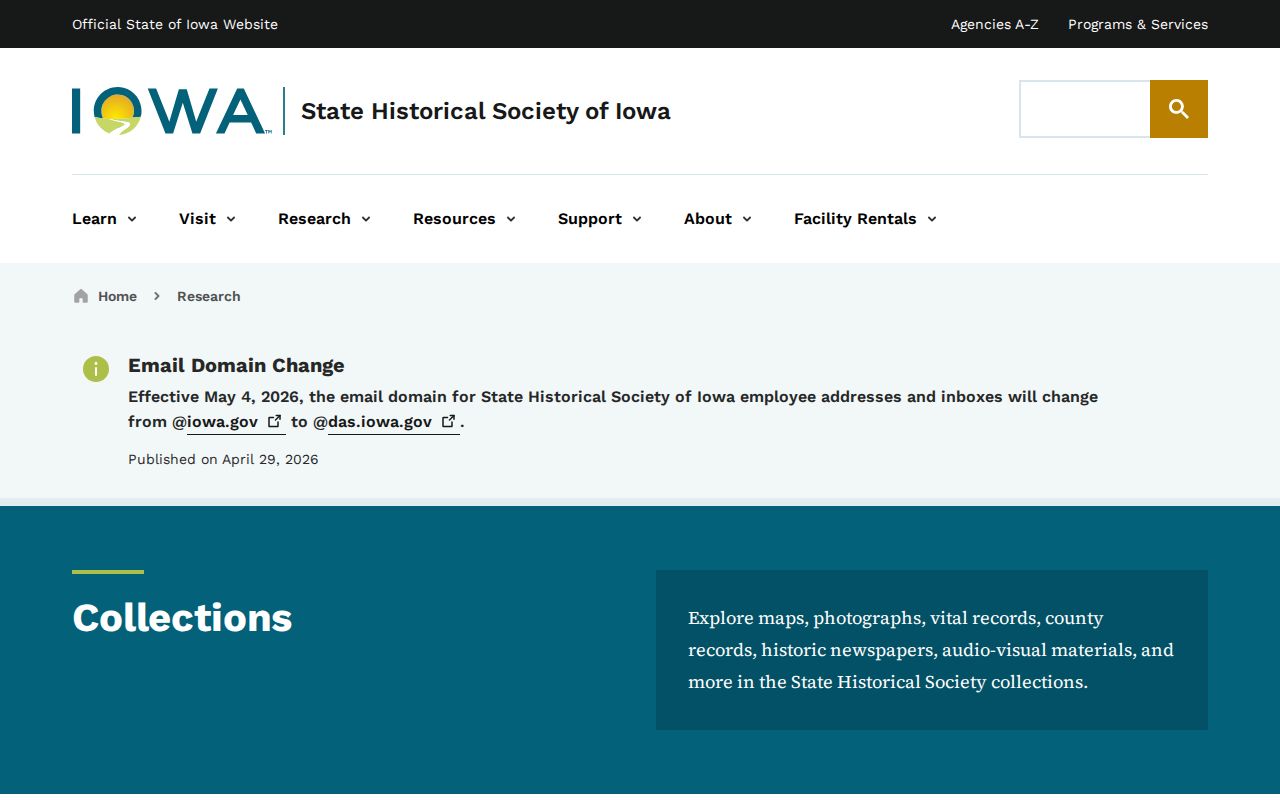
The state collections screen is the fallback when a Cedar Rapids volume points to an older county record, map, census page, or state archive series.
FamilySearch's Linn County catalog is another route to historic births, deaths, marriages, probate, naturalization, divorce, and name-change records. Some images require sign-in, affiliate access, or remain restricted. Catalog presence alone never guarantees a viewable image.
Trace Linn County Families
Work year by year, and keep each claim tied to a page. The method helps distinguish a move from an OCR miss and shows when a person may have changed names. Pair directory editions with released federal census records through the National Archives census route. Federal census schedules follow a 72-year release rule, so there is no public census counterpart for recent city directory years.
- Start with a known Linn County name, address, deed, obituary, or census year. Open the closest directory edition.
- Check both the surname list and street section. Save the quadrant, occupation, phone, household wording, title, and page.
- Move to the prior and next available editions. Mark each appearance, address shift, spelling change, and missing year.
- Compare a released census, newspaper, Sanborn map, school annual, or local-person file near the same date.
- Use a deed, vital index, probate file, or certified record only when the needed fact falls within that source's access rules.
Disappearance can mean a move, death, marriage, omission, or a poor scan. Check a spouse, initials, the old street name, and nearby years before reaching a conclusion. For a modern names-first check, continue through the Linn County resident lookup process rather than treating a historical entry as current.